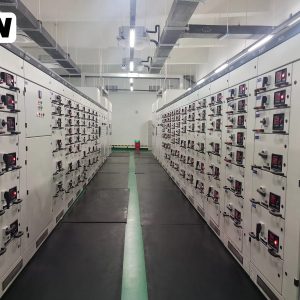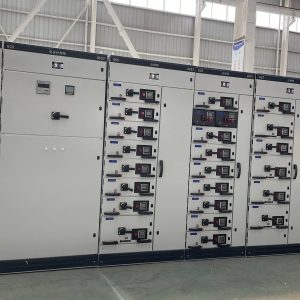
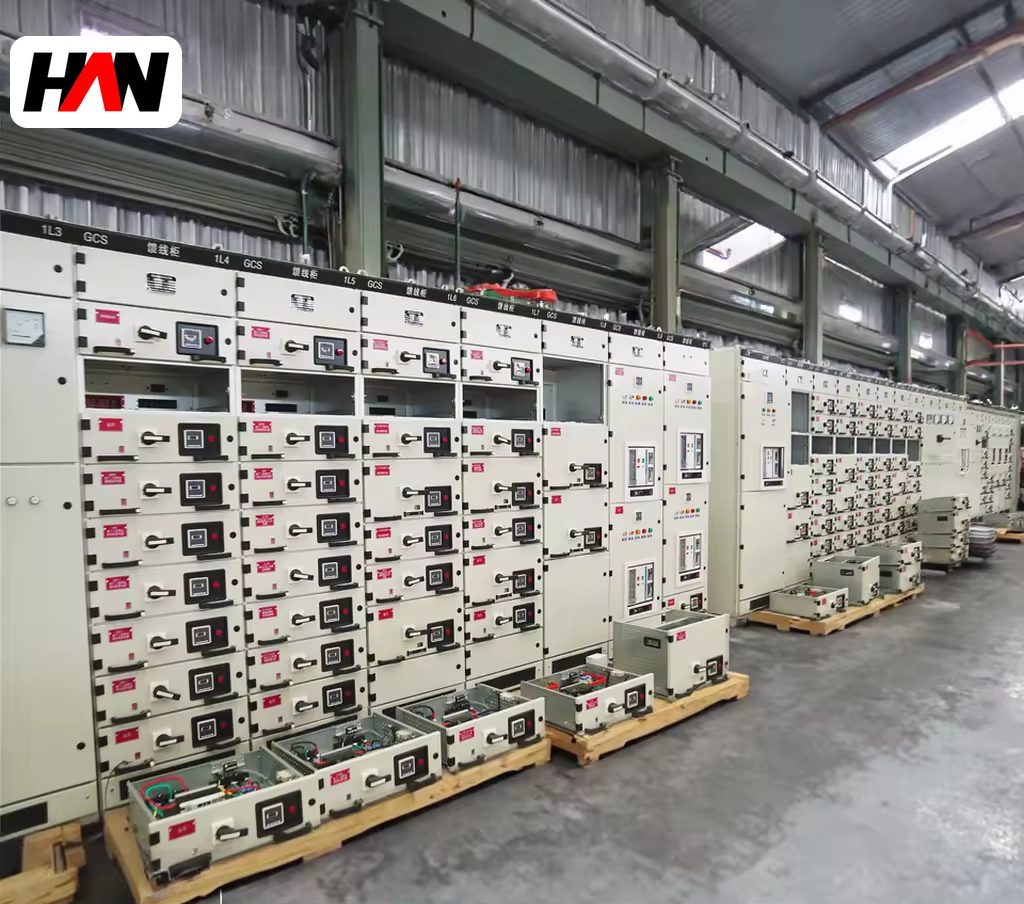
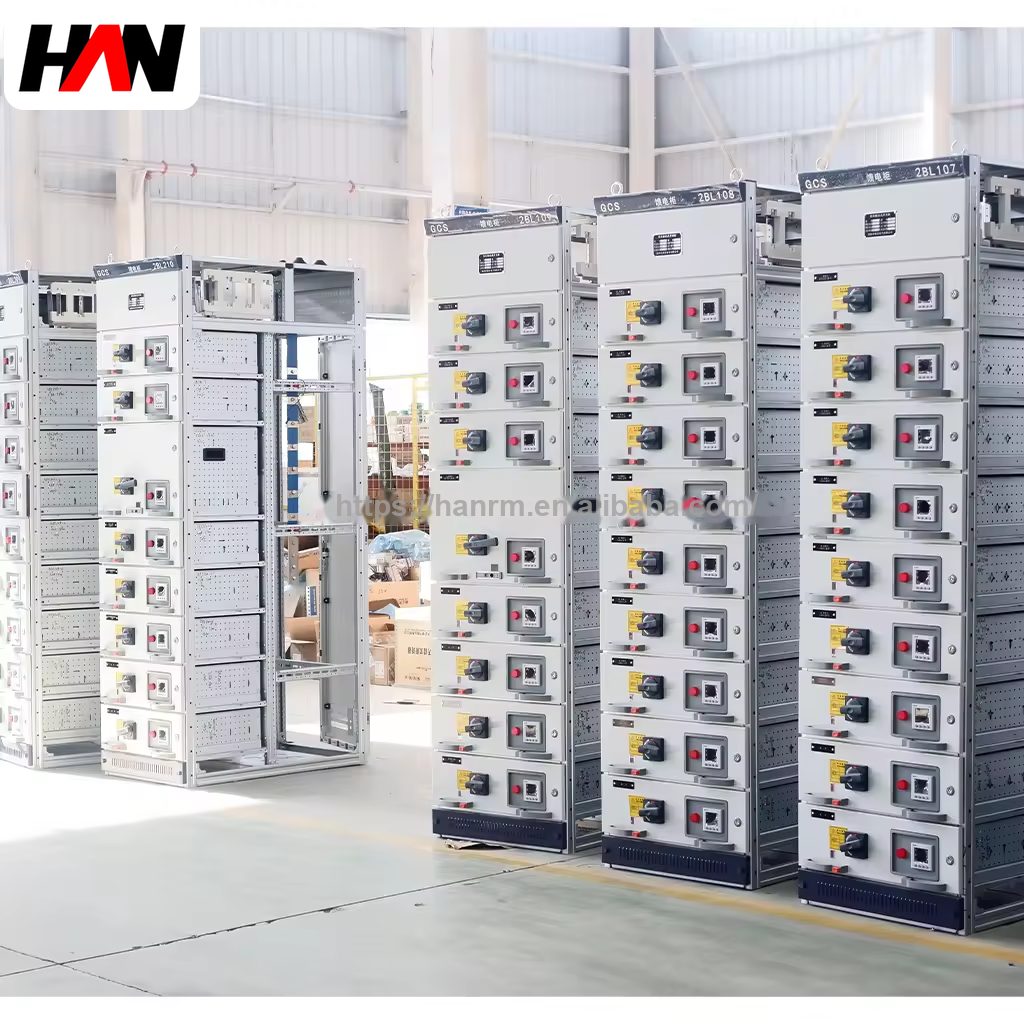
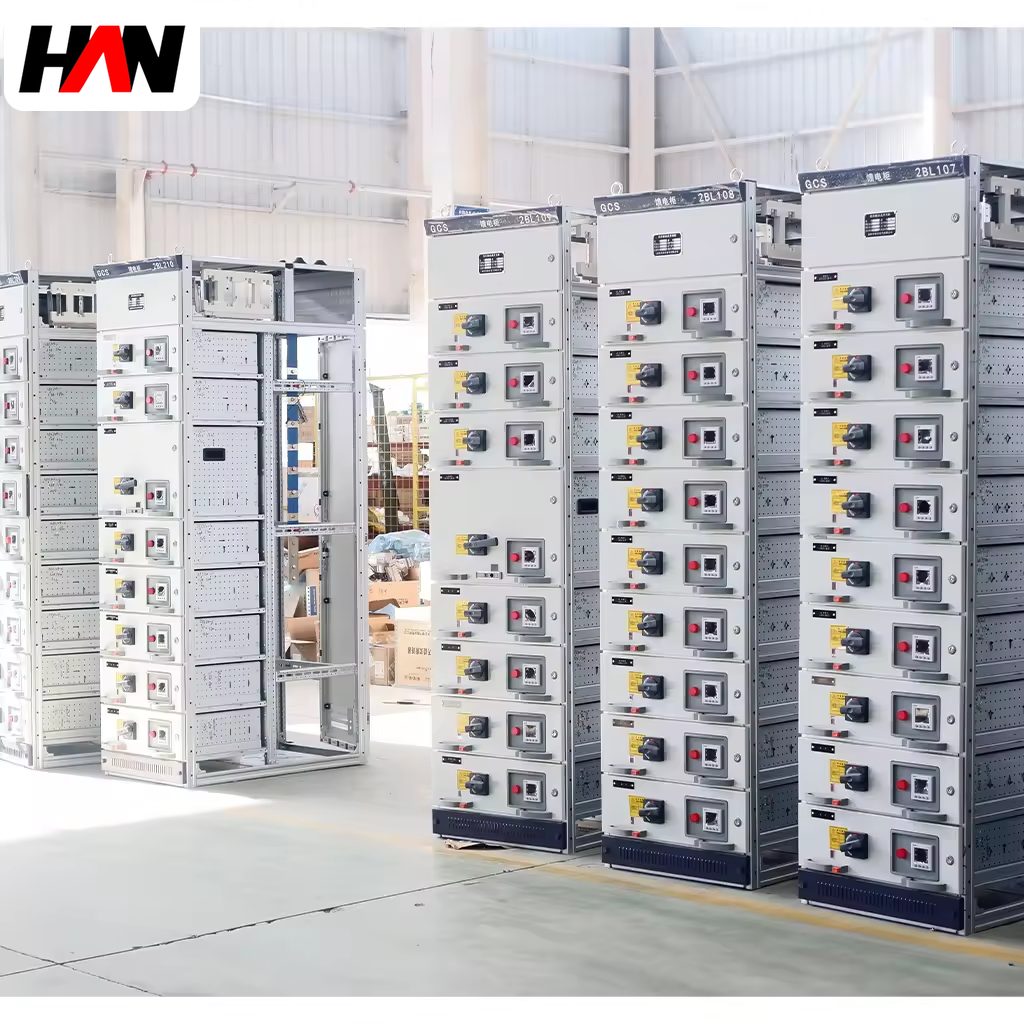
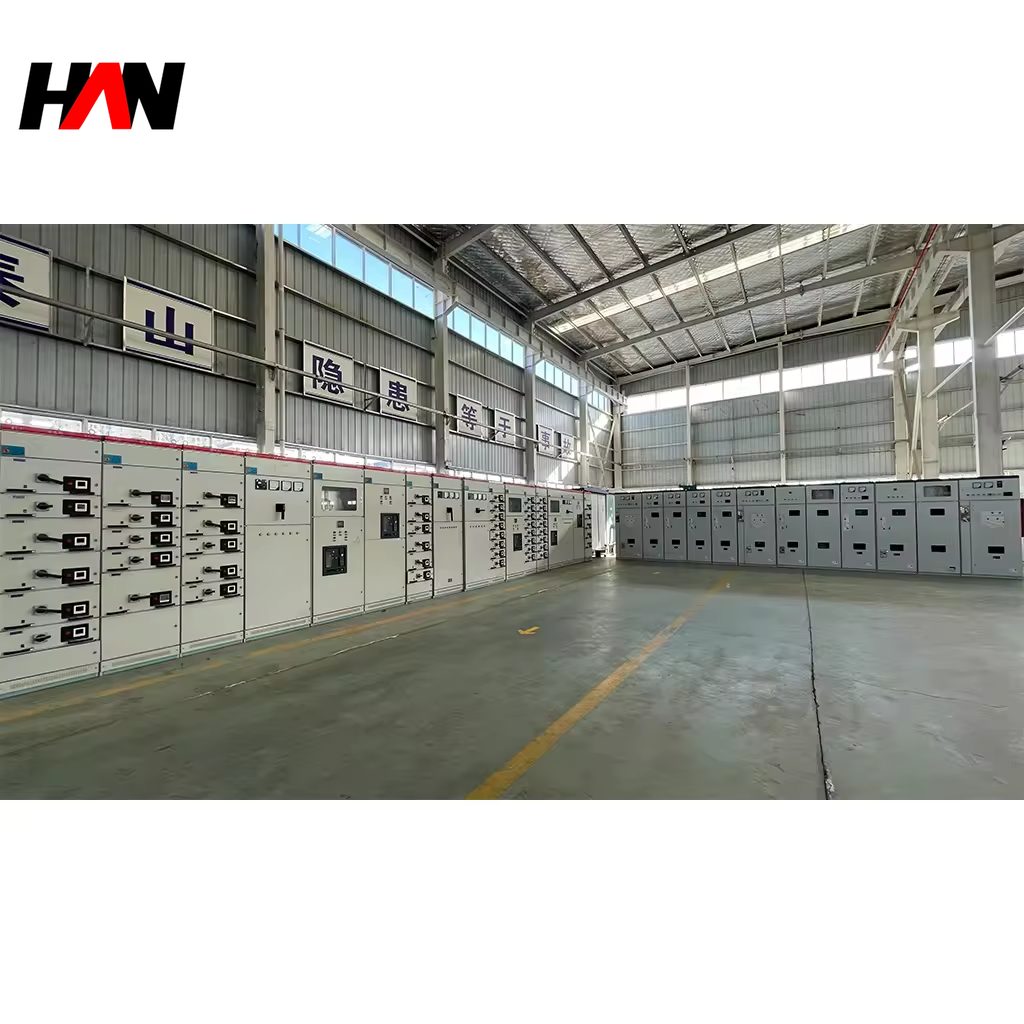
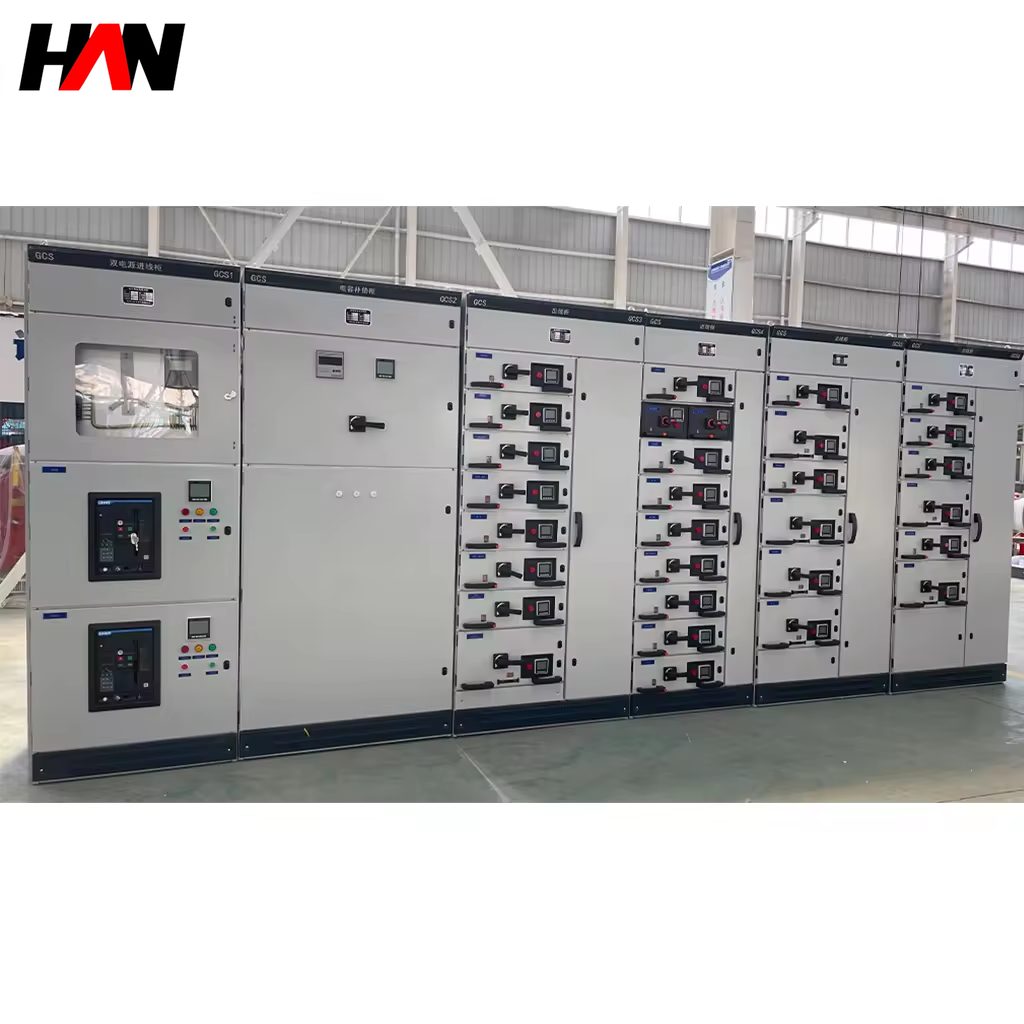
A GGD cabinet is the workhorse of low-voltage distribution in plants that need many outgoing circuits at a controlled cost. It is a fixed, floor-standing assembly. Breakers and switches bolt straight onto the structure, busbars run in their own chamber at the top, and cables land in a compartment at the bottom. Nothing slides and nothing racks in or out. That simplicity is the whole point. Fewer moving parts give a shorter bill of materials, a stiffer busbar system and less to go wrong when a fault hits. This page explains how the design works, which numbers actually constrain a project, and where a fixed cabinet stops being the right answer.
At a glance
| Rated operational voltage | 400 / 415 / 690 V AC |
| Rated insulation voltage | 690 V standard |
| Main busbar current | 630 – 3 150 A |
| Short-time withstand | 15 / 30 / 50 kA, 1 s |
| Internal separation | Form 1 to Form 4 |
| Degree of protection | IP30 – IP54 |
| Design standard | IEC 61439-1 / -2 |
What the three letters describe
GGD is a Chinese designation for a fixed-type AC low-voltage distribution cabinet, and the naming habit has followed the equipment into export markets. Read it as a construction type, not a performance class. The first letter marks it as a low-voltage distribution unit, the second as fixed rather than draw-out, and the third as a power distribution application rather than motor control.
In the international framework it sits inside IEC 61439, which replaced IEC 60439-1 in 2014. Part 1 sets the general rules for any assembly, and part 2 covers power switchgear and controlgear assemblies specifically. Design documents written before 2014 often still cite the old number, and that is acceptable for reference, but a cabinet built today should be verified against 61439. The practical differences show up in verified design, routine verification, and the temperature-rise and short-circuit documentation the builder has to keep.
The family around it matters as much as the designation. Fixed cabinets such as GGD sit at the cheap, rigid end. Draw-out designs — GCS, GCK, MNS — cost more and give you a faster swap of a failed feeder, at the price of contacts, guides and interlocks that all need maintenance. A plant usually ends up with both: fixed cabinets for distribution and capacitor duty, draw-out for motor control centres where a stoppage is expensive.
Three working zones inside the enclosure
A GGD section is laid out in horizontal bands. Keeping them apart is what makes the cabinet safe to inspect without shutting the whole board down.
The busbar chamber holds the main horizontal bars and the tap-off connections. Putting it at the top keeps it short, keeps it dry, and keeps it away from cable pulling debris. The device compartment carries air circuit breakers, moulded-case breakers or fused switch-disconnectors on galvanised mounting plates. The cable chamber below gives room for lugs, glands and a bending radius that will not strain the conductor.
Frames are usually built from 2.0 to 2.5 mm cold-rolled steel sheet, with a galvanised sheet or C-profile frame carrying the weight. Powder coating in a light grey such as RAL 7035 keeps the interior bright, which matters more than it sounds when someone is working with a torch in a dark electrical room. Section widths run from 600 to 1 000 mm, depths from 600 to 800 mm, and heights sit around 2 200 mm so that a breaker handle lands at a workable height.
Ratings, and what each number actually controls
Catalogues list a dozen figures. Only a few of them decide whether the cabinet survives the network it is bolted to.
| Parameter | Typical value | What it constrains |
|---|---|---|
| Rated operational voltage, Ue | 400 / 415 / 690 V | Insulation coordination and device selection |
| Rated insulation voltage, Ui | 690 V | Clearance, creepage and the dielectric test level |
| Main busbar current | 630 – 3 150 A | Transformer size the board can carry |
| Short-time withstand, Icw | 15 / 30 / 50 kA, 1 s | Fault level at the incoming terminals |
| Rated peak withstand, Ipk | 2.1 × Icw at 50 Hz | Electrodynamic force on bars and supports |
| Rated diversity factor | 0.7 – 0.9 typical | Connected load versus busbar rating |
| Form of internal separation | Form 1 – Form 4 | Whether busbars stay live during maintenance |
| Degree of protection | IP30 – IP54 | Dust and water ingress, per IEC 60529 |
| Ambient temperature | −5 to +40 °C | Current derating above the 24 h mean of 35 °C |
| Installation altitude | ≤ 2 000 m | Air density, hence cooling and dielectric strength |
| Pollution degree | 3 | Creepage distance for the environment |
| Enclosure sheet | 2.0 – 2.5 mm steel | Mechanical strength and corrosion reserve |
Engineering note. A cabinet cannot honestly be both a fixed low-voltage type and a medium-voltage class. GGD assemblies operate at Ue of 690 V or below. Listings that describe a cabinet at 12 kV or 24 kV are mixing a low-voltage construction name with a medium-voltage level. A 12 kV requirement is met by metal-enclosed switchgear to IEC 62271-200, with vacuum interrupters, a different insulation system and a completely different busbar geometry. Reading the voltage class before the model code saves a lot of rework.
Heat and fault current behave differently in a fixed design
Two physical problems decide most of the engineering. The first is temperature. Current in a busbar produces heat in proportion to the square of the current, and that heat has to leave through convection and radiation from the enclosure surface. IEC 61439-1 sets limits on the temperature rise above ambient rather than absolute temperatures, which is why a cabinet rated at 40 °C ambient will not simply carry nameplate current at 55 °C. Above 40 °C, either derate the busbar or add forced ventilation. Terminals for external conductors sit around a 70 K rise limit, with larger allowances on bare busbar; the exact value depends on the conductor finish and is tabulated in the standard.
The second is the fault. A short circuit produces a magnetic force between parallel bars that rises with the square of the peak current, and that peak is not simply the fault current you calculated. IEC 61439-1 defines it as a multiple of Icw — about 2.1 times at 50 Hz and 2.2 times at 60 Hz — which is why a 50 kA board is being pushed toward 105 kA peak. Bar supports in a fixed cabinet are spaced to take that force without permanent deformation, and the bolted joints are what keep resistance low and the joint cool.
Because there are no drawers, there is also no path for an arc to travel from one functional unit to the next along a sliding contact. Internal arc withstand is not a mandatory part of IEC 61439. Guidance for testing an LV assembly under arcing conditions is published separately in IEC/TR 61641, and a project that cares about it should ask for that test rather than assume it.
Fixed against draw-out, on the numbers
| Criterion | Fixed cabinet | Draw-out cabinet |
|---|---|---|
| Purchase cost | Lower: no drawer hardware | Higher: guides, contacts, interlocks |
| Mean time to restore | Bus section must be isolated first | Feeder swapped in minutes |
| Busbar rigidity | Bolted, very stiff under fault | Contact clusters add resistance paths |
| Maintenance wear | Almost none in the structure | Contacts and mechanisms need attention |
| Best fit | Distribution, capacitor, lighting, small feeders | Motor control centres in continuous process |
Where it sits in a distribution chain
The usual arrangement runs from the transformer secondary to a main incoming breaker, then onto the cabinet busbar, then out through feeders. Downstream of the feeders sit motor control centres, sub-distribution boards, final boards such as a PZ30 consumer unit, and dedicated panels for power factor correction. Upstream, the cabinet has to be coordinated with the transformer impedance and the utility fault level, because those two numbers set the kA the board will see.
The sectors that buy fixed cabinets in volume tend to be the ones with dense low-voltage loads and long rows of identical feeders: steel and rolling mills, cement lines, water and wastewater treatment, mining conveyors, paper machines, and the AC collection side of solar and battery storage plants. Commercial buildings use the same construction for main distribution and rising mains, where the cabinet sits in a basement electrical room and nobody expects to swap a feeder while the building stays live.
Specification and commissioning checklist
- Fix the fault level first. Get the kA at the LV terminals from the utility or the transformer data, then choose Icw with margin. Choosing the busbar current first and the fault rating later is how boards get replaced.
- Size the busbar on diversity, not on the sum. Total connected load is almost never the operating load. Apply a diversity factor and still keep 20 to 25 percent spare for later feeders.
- Pick the form of separation from the maintenance policy. Form 1 is enough when the plant shuts down for service. Form 3b or 4 pays for itself where a bus section has to stay live while a feeder is worked on.
- Decide cable entry before fabrication. Top or bottom entry, gland plate material, and the space needed for large aluminium lugs change the section layout.
- Match IP to the room, not to the catalogue. IP54 with anti-condensation heaters suits a humid plant room; IP30 with filters is cheaper and cooler where the room is clean.
- Agree the routine tests. Insulation resistance, dielectric withstand at the level tabulated for Ui in IEC 61439-1, continuity of protective bonding, and a functional check of every breaker and interlock.
Frequently asked questions
Is a GGD cabinet the same thing as low-voltage switchgear?
It is one construction type within that category. Low-voltage switchgear also covers draw-out designs such as GCS, GCK and MNS. The shared part is the standard, IEC 61439; the difference is whether functional units can be withdrawn.
Can a fixed cabinet really reach 3 150 A?
Yes, with a wide copper busbar, adequate support spacing and either a large enclosure surface or forced ventilation. Above roughly 1 600 A the temperature rise becomes the limiting factor, so ask for the verified temperature-rise record rather than a catalogue claim.
What does Form 4 add?
Form 4 separates the terminals for external conductors from the busbars and from each other. You can work on one feeder with the busbar energised and the neighbouring feeders still running. Form 1 gives no such separation, and Form 2 and 3 sit in between.
Can a variable frequency drive be mounted inside?
It can, but plan for it. A drive produces heat that stays inside the enclosure, injects harmonics into the busbar, and often needs a separate shielded cable route. Put drives in their own sections with dedicated ventilation or a heat exchanger, and keep the drive feeder away from instrumentation wiring.
Is it suitable for outdoor installation?
A standard indoor cabinet is not. An IP54 enclosure with anti-condensation heaters and a sunshade can survive a covered outdoor position, but a genuinely exposed site calls for an outdoor enclosure or a prefabricated substation that gives the cabinet a controlled internal climate.
Fixed cabinets are built to order, so busbar current, form of separation, cable entry, metering and the paint finish are all set per project. Send the single-line diagram and the fault level and the section layout can be fixed from those two documents.