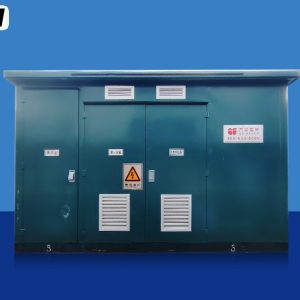
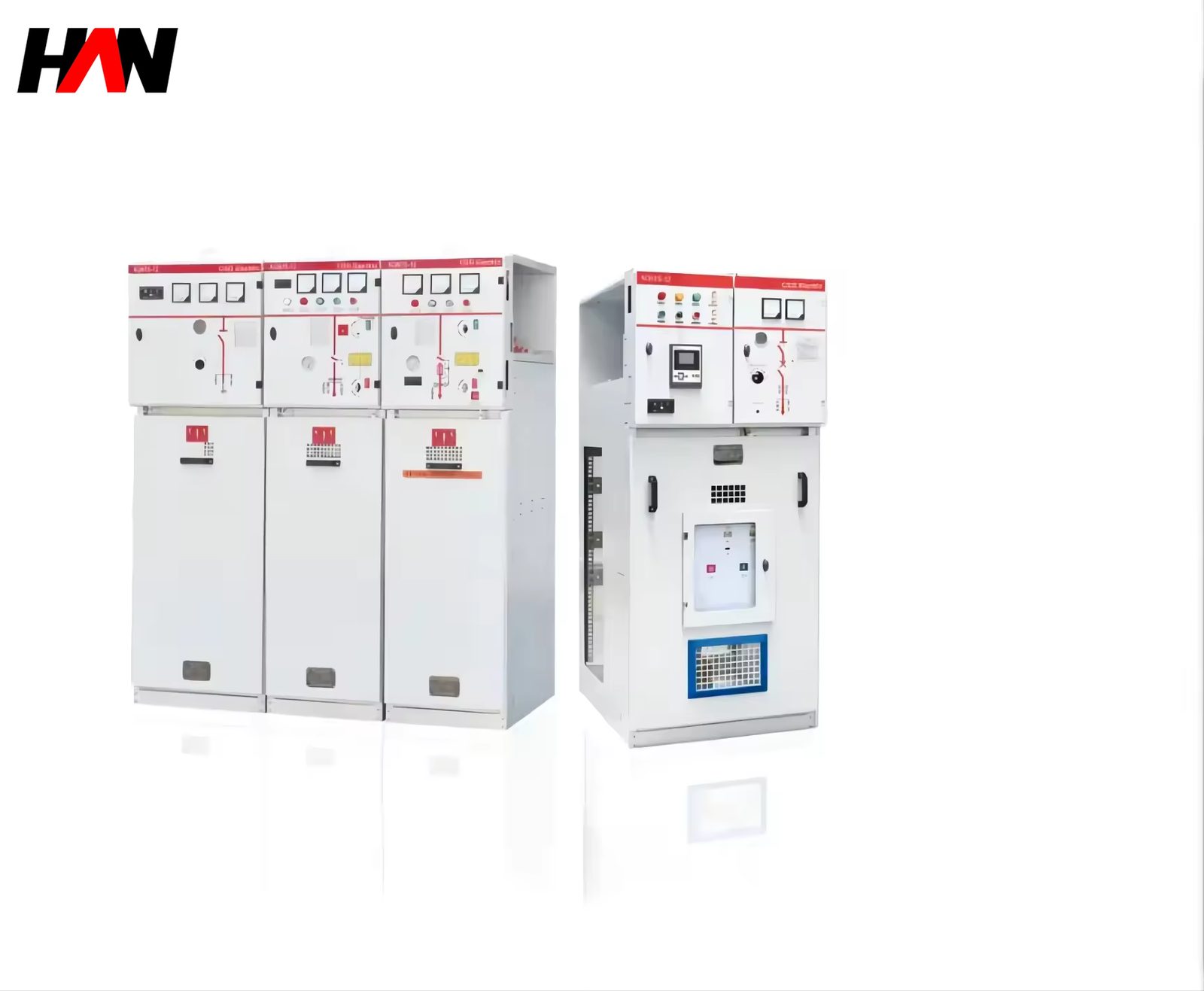
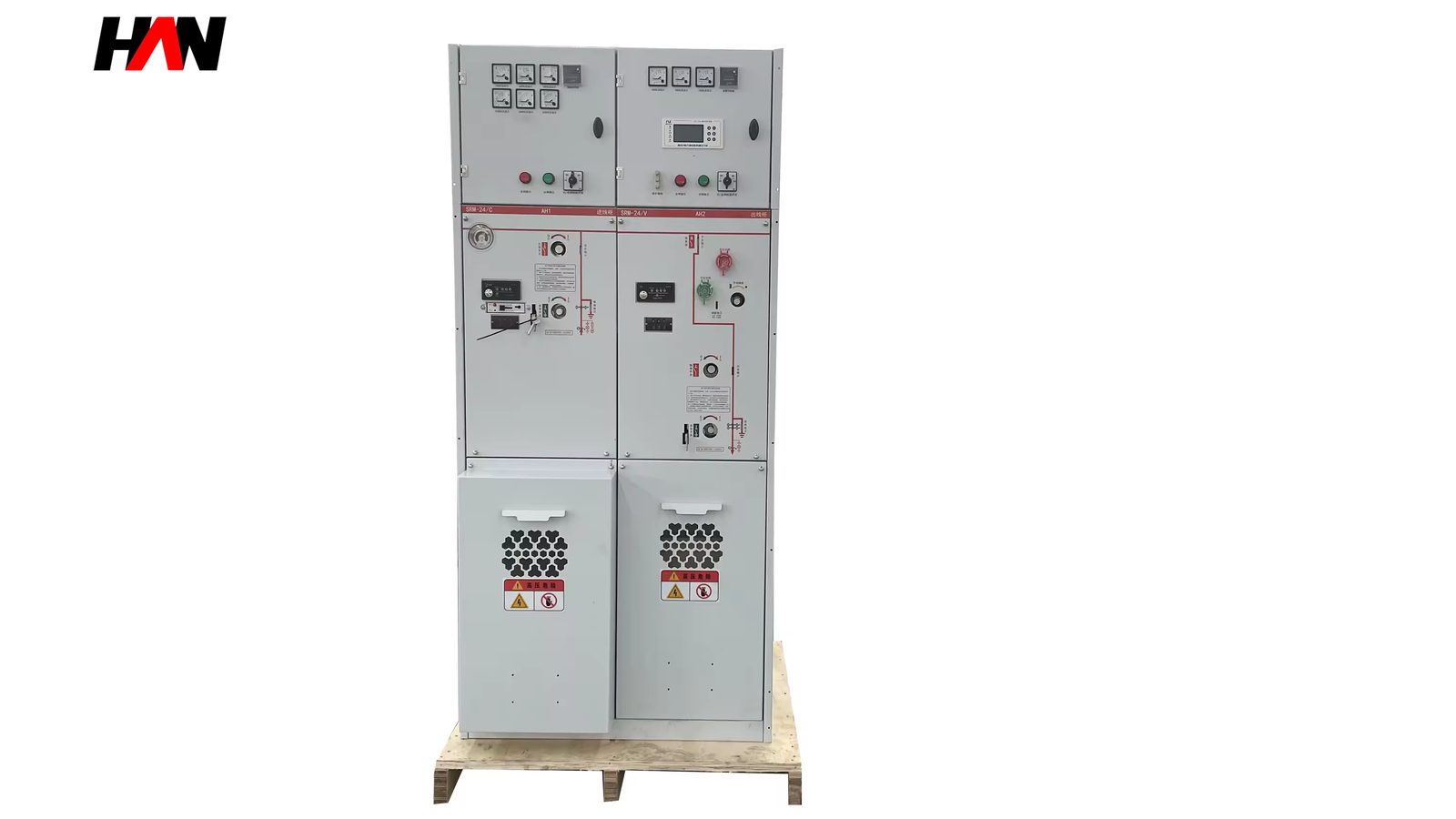
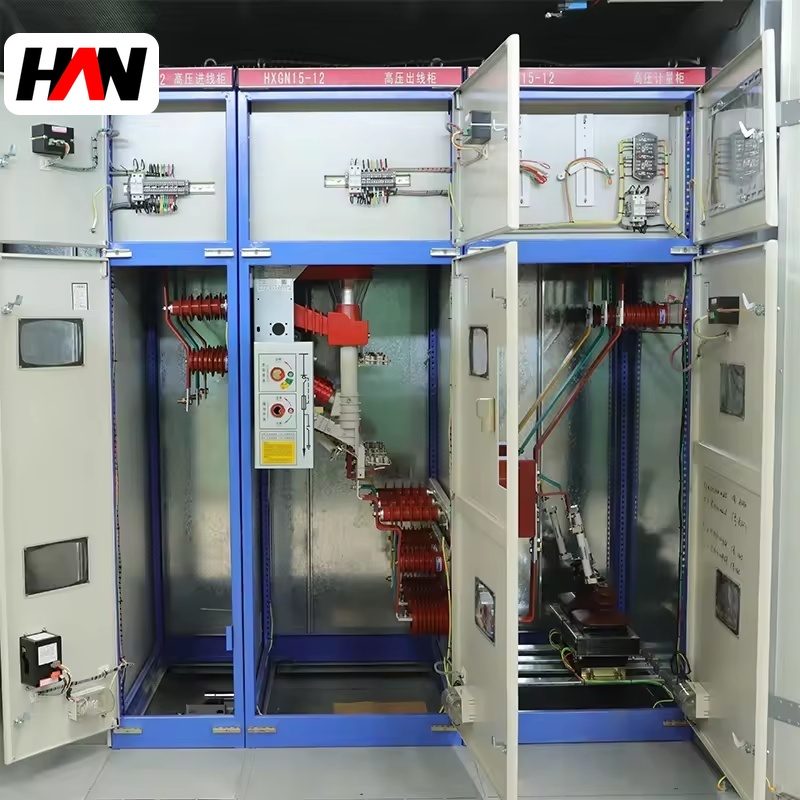
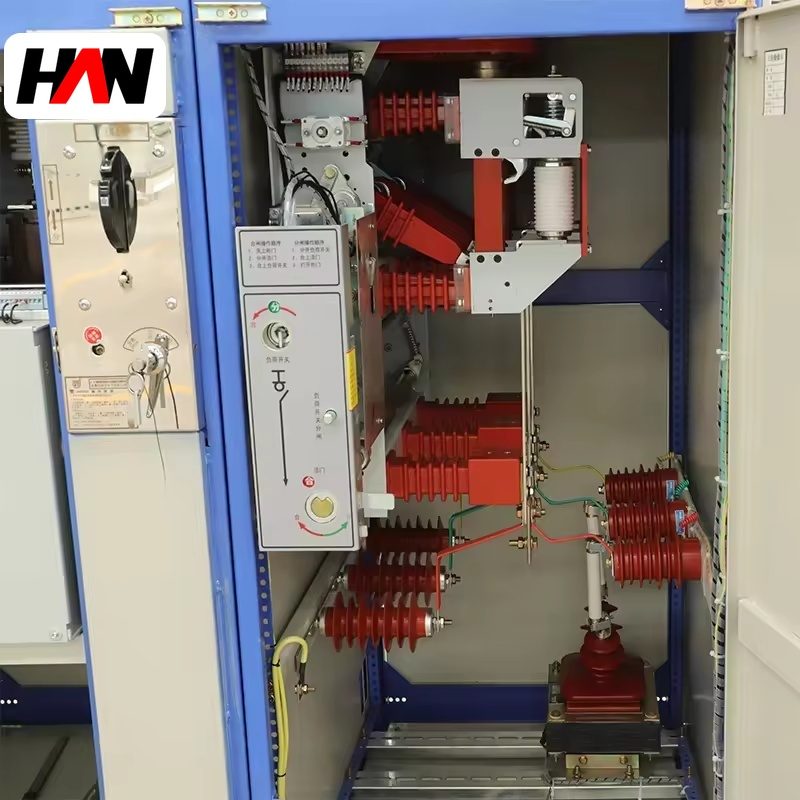
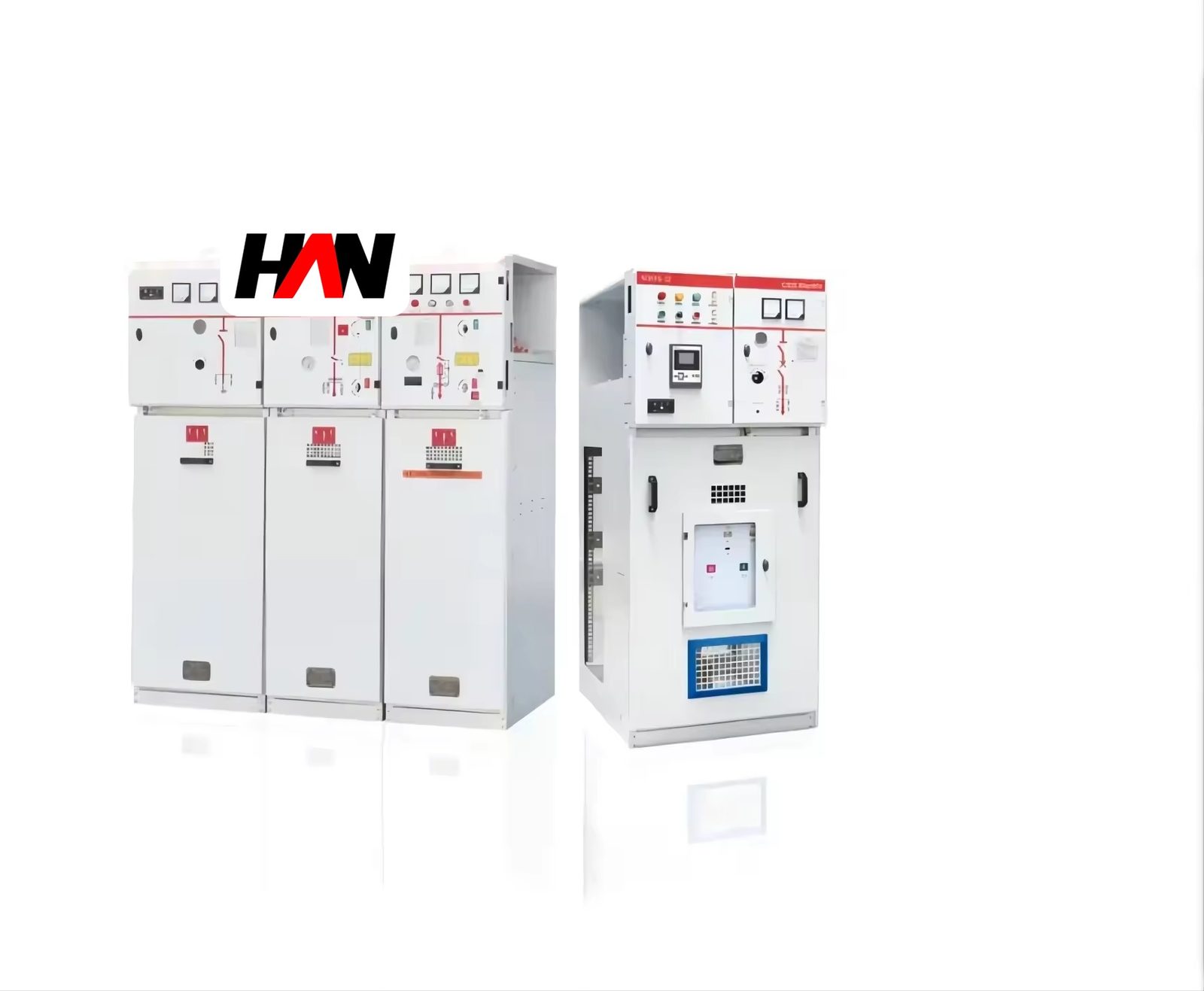
A ring main unit is the small, sealed switchgear cabinet that sits at every node of a medium-voltage ring. Two cables arrive, one leaves, and a transformer tap hangs off the side. Its job is not to break fault current on the ring, because the ring is protected upstream; its job is to let a crew isolate one cable section, earth it, and restore supply to everything downstream through the other path. That single operational idea explains the whole shape of the product: few ways, no instrument transformers on the ring ways, and a switch with three positions instead of two.
The gas-insulated version puts those switches inside a sealed tank, which is why the footprint is measured in hundreds of millimetres rather than metres. Typical ratings are 630 A on the busbar and ring ways and 20 kA for three seconds, across a voltage range from 11 kV to 40.5 kV. This page explains how the three-position switch works, why sulphur hexafluoride became the default filling and why it is now being replaced, and how the sealed tank changes maintenance and end-of-life planning.
At a glance
| Voltage range, Um | 12 / 24 / 40.5 kV |
| Busbar and ring current | 630 A |
| Short-time withstand | 20 kA, 3 s |
| Peak withstand | 50 kA |
| Switch type | Three-position, sealed for life |
| Ways per unit | 3 to 6, extensible or not |
| Transformer protection | Switch-fuse or vacuum breaker |
| Enclosure protection | Tank IP67, cabinet IP33 to IP54 |
| Design standard | IEC 62271-200, IEC 62271-103 |
What a ring node actually does
A medium-voltage ring is a loop of cable that leaves a substation, passes through a series of load points and returns. Each load point has a unit with two ring ways and a tap to a transformer. In normal operation one ring way is closed and the other is closed too, so the loop is electrically continuous, or a point in the loop is deliberately left open so the network runs as two radial feeders. Both arrangements are common, and the choice is a network policy decision rather than an equipment one.
The equipment requirement follows from the operation. If a cable section fails between two nodes, a crew opens the switches at both ends of that section, earths both ends, and closes the normally open point. Every customer downstream is fed from the other direction within minutes. The switch never had to interrupt a fault; it only had to break load current and carry fault current long enough for the upstream breaker to trip. That is why a ring way is rated for making and breaking load, and for withstanding short-circuit current, but not for breaking short-circuit current.
The transformer tap is the exception. A transformer fault is a real fault, and something has to clear it locally. Two solutions dominate: a switch-fuse combination, where a high-voltage fuse clears the fault and the switch provides isolation, or a vacuum circuit breaker with a relay and current transformers. The fuse is cheaper and needs no battery; the breaker can be reset and can be given a wider protection setting. IEC 62271-105 covers the switch-fuse combination as a single assembly, which matters because the coordination between the two devices is what makes it safe.
Why gas, and why three positions
Sulphur hexafluoride is an electronegative gas: its molecules capture free electrons and form heavy negative ions that move slowly and recombine rather than starting an avalanche. The practical result is a dielectric strength roughly two and a half to three times that of air at the same pressure, and a much better ability to quench an arc. A switch that needs 300 mm of air at 40.5 kV can do the same job in a fraction of that distance in gas at modest pressure. That is the entire reason a ring main unit fits into a cabinet the size of a refrigerator.
The three-position switch is a separate idea and it is about interlocks rather than insulation. One moving contact travels between three fixed positions: closed, open, and earthed. Because the earth position is part of the same mechanism, it is mechanically impossible to have the switch both connected to the cable and connected to earth. A two-device arrangement, with a separate switch and a separate earthing switch, can achieve the same safety through key interlocks, but the single mechanism removes a whole class of operating error. The visible position indicator follows the same logic: what the operator sees is the position of the contact, not the state of a control circuit.
Gas tightness is what makes the design work over decades. IEC 62271-1 defines a sealed pressure system as one that does not need replenishment for its expected life, and requires the manufacturer to state a leakage rate and verify it. A well-built tank loses well under one percent of its filling per year, and the pressure gauge, where one is fitted, is a diagnostic rather than a maintenance instruction. The gas is not consumed by operation; it only escapes.
Construction: tank, bushings and operating access
The switching elements live in a welded stainless steel tank, usually 3 mm sheet, tested for pressure and for leak rate before filling. Cable and bushing connections pass through epoxy bushings that are part of the sealed boundary. Outdoors, the bushings are usually of the screened, separable-connector type so that a cable can be disconnected and the interface re-made with a standard kit rather than a bespoke fitting.
Outside the tank sits everything that has to be touched: the operating levers or motor drives, the position indicators, the padlocking points, the fuse access on a switch-fuse way, and the low-voltage interface for remote control. Keeping that hardware outside the gas boundary is deliberate. A mechanism that can be serviced without opening the tank is the difference between a unit that lasts thirty years and one that needs re-gassing to change a spring.
Extensibility is worth deciding early. A non-extensible unit is welded shut at the factory and cheaper; an extensible one has a busbar interface with insulated caps so another unit can be bolted alongside later. On a housing estate where the load grows in phases, that interface is the difference between adding a unit and replacing a substation.
Ratings, and what each number controls
| Parameter | Typical value | What it constrains |
|---|---|---|
| Highest voltage for equipment, Um | 12 to 40.5 kV | Tank size, bushing length and gas pressure |
| Rated normal current, busbar | 630 A | How much of the ring one node can carry |
| Rated short-time withstand | 20 kA, 3 s | Upstream protection clearing time |
| Rated peak withstand | 50 kA | Busbar bracing inside the tank |
| Rated short-circuit making current | 50 kA peak | Closing onto a fault during restoration |
| Transformer way current | 200 A with fuse, or 630 A with breaker | Transformer rating that can be tapped |
| Gas leakage rate | Below 0.1 percent per year | Whether the unit is truly sealed for life |
| Degree of protection | IP67 tank, IP33 to IP54 cabinet | Ingress per IEC 60529, indoor or outdoor use |
| Ambient temperature | −25 to +40 °C | Gas pressure behaviour and cabinet sealing |
| Mechanical endurance | Class M1 or M2 to IEC 62271-103 | Operating cycles before mechanism overhaul |
The three-second duration on the short-time rating is not a formality. It reflects how long a distribution network’s upstream protection may take to clear a fault, which is longer than the half second typical on an industrial board because the fault current is lower and the grading margins are wider. A unit rated 20 kA for one second instead of three is a different product with thinner internal bracing, and the difference is invisible from outside the tank.
Engineering note. A sealed tank is not a maintenance-free tank in the sense that nothing needs checking. The gas boundary needs no work, but the mechanism, the fuses, the cable terminations and the pressure indicator all do. What changes is the skill required: opening a gas compartment requires recovery equipment and a procedure under IEC 62271-4, and a site that has never handled the gas should not plan to start on a Tuesday afternoon. Ask for the filling quantity and the gas type at the quotation stage, not at the end of life.
Heat, fault current and the greenhouse problem
Thermally, a gas-insulated unit is easy in service and awkward at the edges. The current path is short and the tank has a large surface relative to its volume, so 630 A is comfortable. The difficulty is that the gas density, and therefore the dielectric strength, depends on temperature and pressure together. A cold night lowers the pressure inside a sealed tank, and the design must still hold its insulation level at the lowest expected ambient. That is why the ambient range is stated on the nameplate and why a unit built for a temperate climate should not be installed in a desert without checking.
The environmental issue is now a design driver. Sulphur hexafluoride has a global warming potential of roughly 23 500 times that of carbon dioxide over a hundred-year horizon, so a single kilogram of filling is equivalent to more than twenty tonnes of carbon dioxide if released. A well-sealed unit almost never releases it, and end-of-life recovery under IEC 62271-4 prevents most of the loss, but the accounting is unforgiving: a utility with a thousand units is managing a material stock measured in tonnes of equivalent emissions.
That pressure has produced three credible alternatives. Dry air at higher pressure uses the same sealed-tank architecture with a gas whose warming potential is effectively nil, at the cost of a larger tank for the same rating. Solid insulation moulds the live parts into epoxy with vacuum interrupters, removing the gas entirely and making the unit easier to recycle, at the cost of more material and a heavier casting. Fluoronitrile mixtures reduce the warming potential by an order of magnitude while keeping the tank close to its original size. All three are legitimate answers, and the choice usually comes down to the network operator’s asset policy rather than to the switchgear itself.
Comparing insulation options
| Option | Footprint | End of life | Trade-off |
|---|---|---|---|
| SF6 tank | Smallest | Gas recovery and reporting | Highest warming potential |
| Dry air tank | Slightly larger | Vent to atmosphere | Higher pressure, thicker tank |
| Solid epoxy insulation | Compact, but heavier | No gas handling at all | Partial discharge control in the casting |
| Air-insulated fixed cabinet | Largest by far | Simple scrap value | Needs a room, not a pad |
Where it fits in the network
The unit sits between the distribution cable and the distribution transformer, usually on a pad at the edge of a street, inside a housing estate, on an industrial estate service road or at the foot of a wind turbine. Upstream is the primary substation with its circuit breakers and its protection; downstream is a 11 kV to 0.4 kV transformer, or sometimes a second ring that serves a further group of nodes. Large plants use the same product internally, as node switches on an in-plant ring feeding packaged substations.
The sectors that buy them in volume are utilities, property developers, light industry, water pumping and renewable collection networks. What they have in common is geography: load spread over a wide area, cables rather than overhead lines, and a maintenance crew that arrives by van. A compact sealed unit suits that pattern because it needs no building, no fence in many cases, and no room to rack a breaker out.
Selection and commissioning checklist
- Count the ways and decide extensibility. Two ring ways plus a transformer tap is the minimum; a spare way or an extensible busbar interface costs little at order and a great deal later.
- Choose fuse or breaker for the transformer. A fuse is simpler and needs no auxiliary supply; a breaker resets and can be integrated with remote control.
- Confirm the cable interface type. Screened separable connectors are the norm outdoors, and the bushing type decides which cable kits will fit.
- Check the short-time duration against upstream grading. Three seconds is normal for distribution; a one-second rating may not cover the trip time of the feeding breaker.
- Agree the gas record at handover. Gas type, filling mass, pressure at 20 °C and the leak rate belong in the commissioning file, because they are needed for the whole life of the asset.
- Verify the mechanical interlock by operation. Every unit should be cycled through closed, open and earth positions, and padlocking proved, before the cable is terminated.
Frequently asked questions
Can a ring main unit clear a fault on the ring cable?
No. The ring ways are rated to make and break load current and to withstand fault current, not to interrupt it. Fault clearance is the job of the upstream breaker at the primary substation, which is why the short-time duration matters more than a breaking rating on those ways.
What happens if the gas pressure drops?
The insulation margin falls, so the unit should be treated as degraded and the cause found. A sealed unit should not lose pressure in normal service; a drop points to a leaking joint, a damaged bushing or a faulty gauge, and the response is recovery and repair rather than topping up.
Is a gas-insulated unit allowed under current environmental rules?
In most markets yes, with reporting and recovery obligations that vary by jurisdiction. The trend is toward lower-warming-potential designs, so a specification that will still be defensible in ten years usually asks for the gas type and its warming potential to be declared.
How long does one last?
The sealed boundary is normally designed for a service life of several decades, with the mechanism and the fuses as the parts that need attention. The realistic constraint is often the cable terminations and the enclosure finish rather than the switch itself.
Way count, voltage class, fuse or breaker tap, cable interface, enclosure rating and remote control options are all set per project, so the configuration follows from the ring diagram and the transformer schedule.