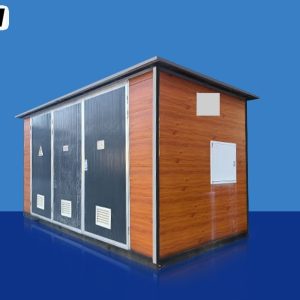
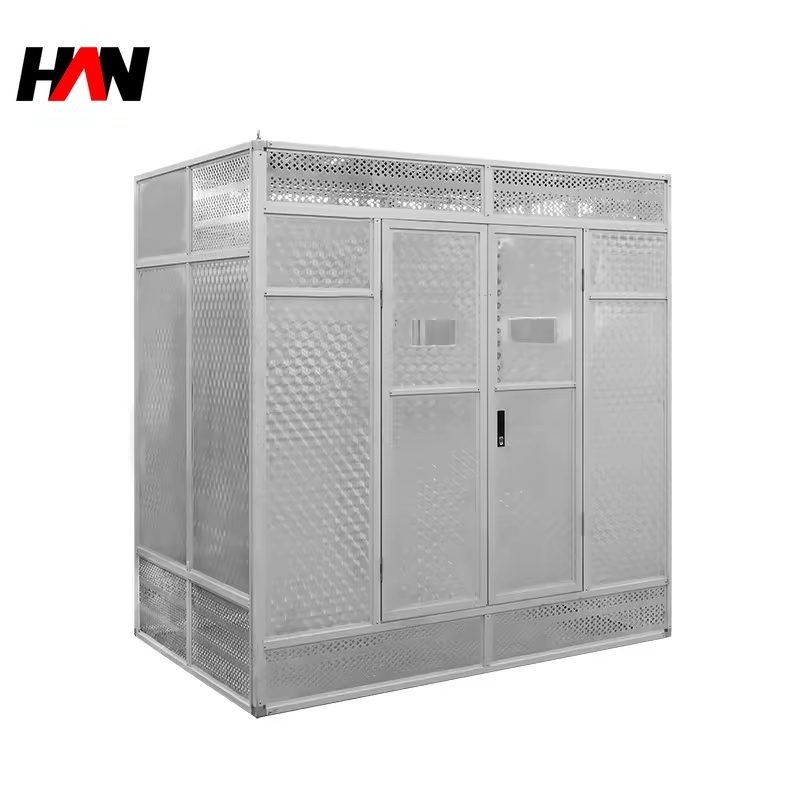
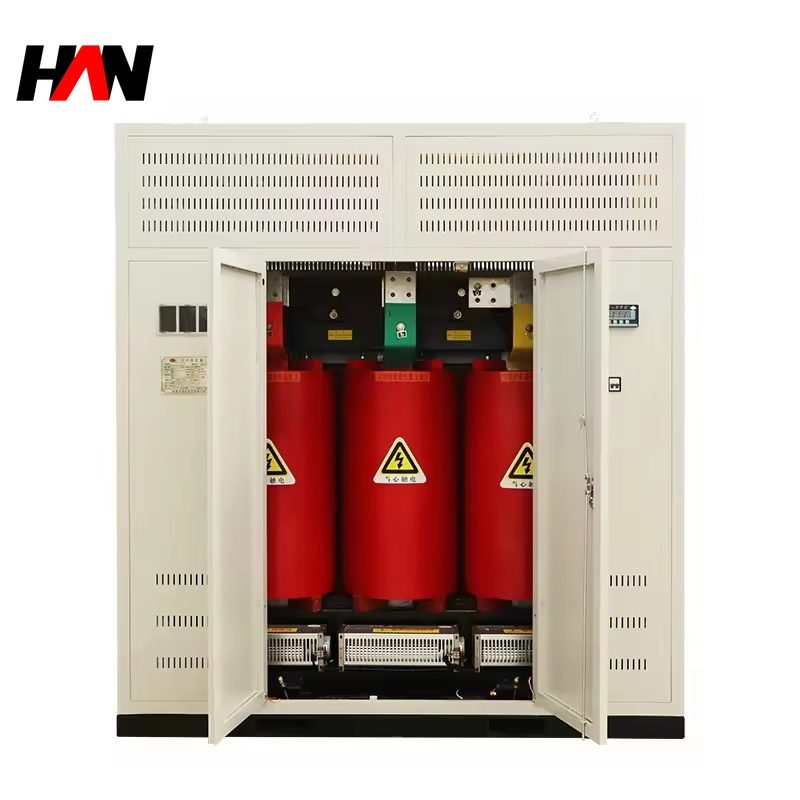
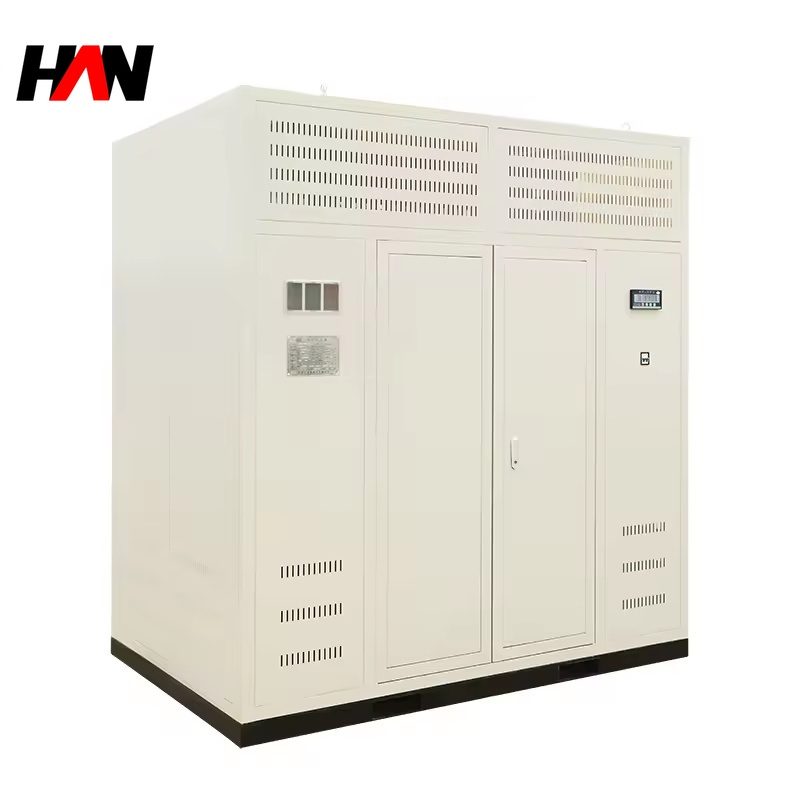
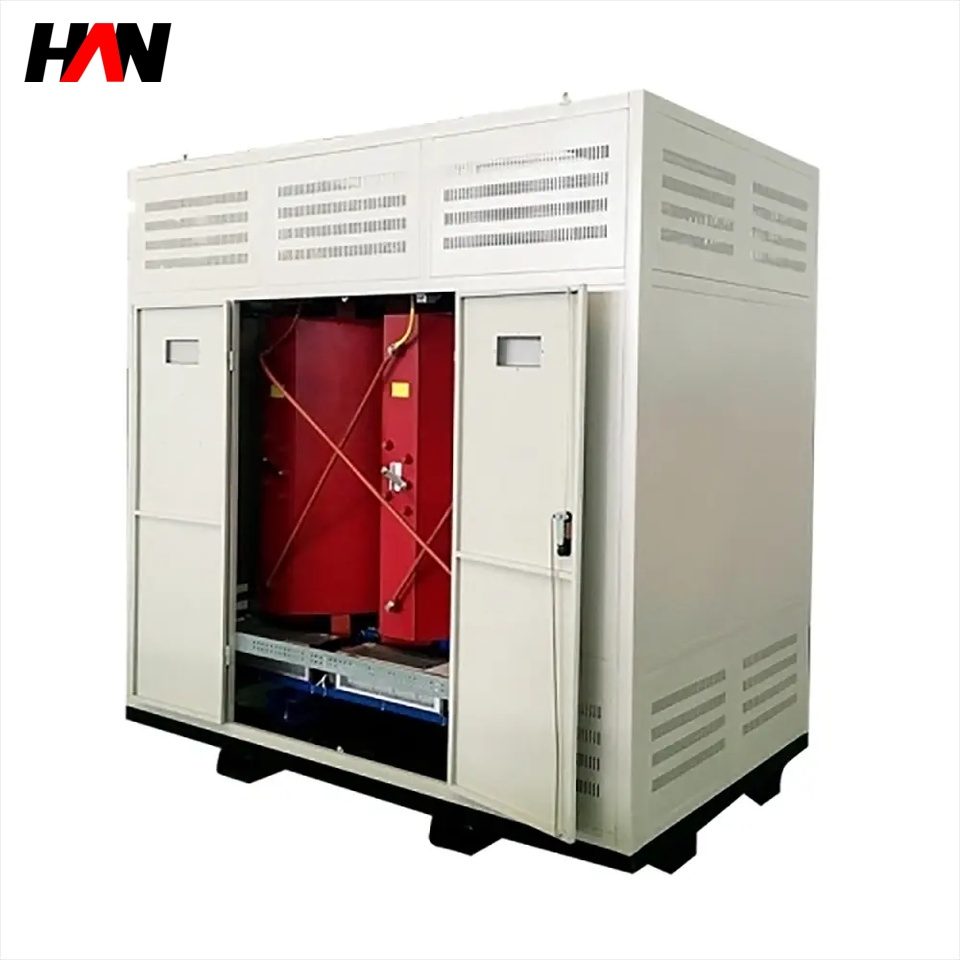
An enclosure for a dry-type transformer looks like a simple sheet metal box, and that is how it is often bought: as an accessory, priced by the square metre, chosen at the end of the project when the transformer has already been ordered. The box then decides whether the transformer survives. It has to keep rain, dust, birds, rodents and solar heat away from a casting that is only a few millimetres thick, while still removing every watt of loss the transformer produces. Those two duties pull in opposite directions. A sealed box is dry but hot; an open box is cool but wet. The engineering is entirely in the compromise, and in the arithmetic that proves the compromise works for a specific site, a specific loss figure and a specific ambient temperature.
At a glance
| Degree of protection | IP54 to IEC 60529 |
| Enclosure material | Stainless steel 304 or 316L |
| Sheet thickness | 1.5 – 2.5 mm panel, 2.0 – 3.0 mm frame |
| Transformer inside | Cast resin dry type, 50 – 2500 kVA |
| Typical application | 100 kVA, 11 kV / 415 V, three phase |
| Ventilation | Low inlet louvre, high outlet louvre, insect mesh |
| Corrosion category | C3 to C5 per ISO 12944, CX on request |
| Ambient range | -25 to +50 °C, site dependent |
| Reference standards | IEC 60529, IEC 60076-11 |
What the two digits actually promise
The IP code in IEC 60529 has two digits and they are frequently misread. The first digit covers solids. A 5 means dust protected: dust can enter, but not in a quantity that interferes with satisfactory operation or safety. A 6 means dust tight, with no ingress at all. The second digit covers water. A 4 means protection against splashing water from any direction, which is a rain-and-hose test, not immersion. Combining them, IP54 says the enclosure tolerates weather and washdown splashes without letting enough dust in to cause trouble.
That distinction matters because a dry-type winding is not damaged by a little dust; it is damaged by a dust layer that insulates the coil surface and traps moisture. Fine conductive dust, such as carbon black, cement or metal polishing dust, is worse because it can bridge creepage paths. So the honest requirement for an outdoor transformer enclosure is not “sealed” but “keeps the bulk of the dust out and lets the rest be cleaned off”. An IP54 box with accessible louvres and a maintenance routine is usually a better answer than an IP66 box with a heat exchanger, which costs energy to run and cannot be cleaned at all.
Why a dry transformer needs a box, and when it does not
Indoors, a cast resin transformer is often installed open, with a fence or a locked cell around it. The building already provides the weather protection, and open coils cool best. Outdoors the same unit is exposed to four separate problems. Rain and driven spray wet the coil surfaces and the terminal boxes. Airborne dust and pollen coat the castings and clog the ducts between coil layers. Rodents and birds nest in the phase gaps and gnaw at cable insulation, and a bird bridging two phases is a short circuit with feathers. Sun raises the surface temperature of a dark casting well above air temperature and adds a radiant load the thermal design never accounted for.
There is a fifth reason that has nothing to do with weather: access control. An outdoor enclosure with lockable doors keeps unqualified people away from live terminals and gives the utility or the plant a single point at which to isolate. That is why the same box is used on rooftops, on concrete pads beside a building, and on the decks of ships where salt spray is the dominant attack.
The air path, and the arithmetic behind it
Cool air enters low, passes across the coils and leaves high. The arrangement is not decorative: hot air rises, so an outlet at the top and an inlet at the bottom let buoyancy do part of the work, and the temperature inside stratifies in a predictable way. Put the outlet low as well and the top of the box becomes a dead zone holding a pocket of hot air directly above the windings, which is exactly where the hotspot already is.
The air quantity follows from a single relation. Moving heat out of a box requires mass flow, and mass flow times specific heat times temperature rise equals the heat removed. In practical units, roughly three cubic metres per hour of air is needed for every watt of loss divided by the permitted temperature rise in kelvin. A small unit that releases 3 kW of total loss into an enclosure where the air may only rise 10 K therefore needs about 900 cubic metres per hour. That is a real fan or a generous louvre area, and it explains why a 100 kVA transformer in a tight stainless box can need forced ventilation while the same transformer in an open plant room needs nothing.
Louvres are the bottleneck. A pressed louvre blade blocks part of its own opening, so the effective free area is typically half to two thirds of the frame size, and the pressure loss across a louvre rises with the square of the air velocity through it. Insect mesh adds another restriction. Filters add a great deal more, and a filter that is never changed becomes a solid wall within a season. Where filters are specified, the design must include a differential pressure switch or at least a scheduled replacement interval, and the fan must be sized for the dirty filter, not the clean one.
| Enclosure parameter | Typical value | Effect on the transformer |
|---|---|---|
| Ingress protection | IP54 | Dust and splash kept out, airflow restricted |
| Inlet free area | 50 – 65 % of louvre frame | Sets the available cooling air volume |
| Air temperature rise in the box | 10 – 15 K design target | Adds directly to the winding ambient |
| Sunshade or double roof | Recommended above 40 °C ambient | Removes radiant load from the top of the coils |
| Panel material | 304 or 316L stainless | Service life in chloride and industrial air |
| Door and panel sealing | Continuous gasket, stainless hinges | Maintains the IP rating over years of opening |
| Anti-condensation heater | With hygrostat, where humidity is high | Keeps the casting above dew point when idle |
| Cable entry | Bottom, with removable gland plate | Stops water tracking in along the cables |
| Earthing | Dedicated stud, braided door bonds | Fault path that does not rely on hinges |
| Lifting and base | Four lugs, channel base on concrete pad | Weight of box plus transformer, plus wind load |
Engineering note. Raising the IP rating never improves cooling. It only removes routes for air. A unit that carries 1250 kVA in an open plant room may need to be derated in an IP54 box, or given fans, or both, and the derating must appear on the rating plate rather than in an assumption. Ask for the enclosure to be thermally checked against the declared total loss at the site ambient, and ask what happens on the day the filter is blocked or a fan fails.
Stainless steel grades, and what they are chosen for
The common choice is grade 304, an austenitic stainless with roughly 18 % chromium and 8 % nickel. It resists atmospheric corrosion well and is the sensible default for inland industrial sites. Grade 316L adds two to three percent molybdenum and keeps carbon low, which raises resistance to chlorides and to pitting; it is the right choice within a few kilometres of a coast, on a ship, or beside a chlorine or de-icing salt store. Ferritic grades such as 430 are cheaper and magnetic, and are sometimes offered on internal partitions where appearance matters less.
Grade selection only pays off if the fabrication matches it. Welds must be cleaned and passivated, because welding burns out the chromium oxide layer locally and leaves a site where rust starts. Mild steel brackets, hinges, screws or cable glands bolted to a stainless panel create a galvanic couple, and the small anode corrodes quickly. Cut edges should be deburred, and trapped water should be given a drain path, since crevices hold the chlorides that cause pitting. ISO 12944 corrosivity categories from C3 to C5, and CX for offshore, give a language for specifying the finish; ISO 9223 does the same for the atmosphere itself.
Noise, louvres and the cost of quiet
A transformer hums at twice the supply frequency, 100 Hz on a 50 Hz system, plus harmonics, because the core changes shape slightly every half cycle as it magnetises. In an open room that noise leaves through the air. Inside a box it does two things: the panels vibrate and radiate their own sound, and the louvres act as open windows that let the sound out almost unattenuated while the surrounding panels block it. The result is that a well-sealed box with one large louvre is barely quieter than no box at all.
Acoustic treatment therefore costs cooling. Sound-absorbing linings reduce the reverberant field inside the box, and lined splitters or baffles in the air path attenuate the direct path, but both add resistance to the airflow, so the fan has to work harder or the opening has to grow. Where a noise limit at a boundary is the binding constraint, the sequence is to reduce the noise at the source first, then increase panel mass and stiffness to cut radiated sound, and only then add absorption. Buying a thicker box to fix a noise problem that comes from a loose core clamp is money spent in the wrong place.
How this differs from an oil-filled pad-mounted unit
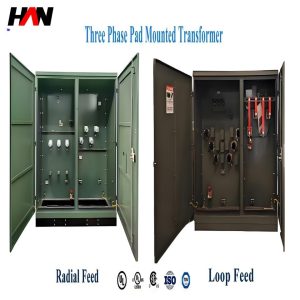
A pad-mounted oil transformer and an enclosed dry unit both sit on a concrete pad outdoors, and the resemblance stops there. The oil unit carries its own cooling in the oil and the tank walls, with radiators that need free air and a visible oil level; it needs a containment volume under it for spill, and clearance for anyone who has to read gauges or top up oil. The dry unit inside a box has no liquid to contain and no oil gauge, but it depends completely on the box for its cooling, so the box is part of the thermal design rather than a cover over it.
The practical consequences show up in layout. A dry unit can be placed hard against a wall or another enclosure because there is no radiator to keep clear, but its inlet and outlet must not face each other across a narrow gap, or it will breathe its own exhaust. The pad needs to be level and thick enough for the point loads at the base channels. Doors need swing room and, in a walk-in design, enough internal height for a person to inspect terminations, which pushes the footprint up again. Cable entry from below means a trench or a raised pad with a duct block.
Specification and commissioning checklist
- Give the loss figure, not just the kVA. The enclosure is cooled against total loss at the site ambient. A vendor who has not been told the loss cannot size the louvres.
- State the site ambient and the sun exposure. A shaded north wall and an unshaded roof in the same city are two different thermal cases.
- Name the stainless grade and the corrosivity category. Distance to the coast and the presence of chlorides decide between 304 and 316L, and the answer should be in writing.
- Agree the maintenance access. Removable louvre panels, hinged doors and a filter change interval decide whether the unit is still clean in five years.
- Check the earthing and bonding detail. A dedicated earth stud plus braided bonds across every hinged door, not reliance on the hinge pin.
- Confirm lifting and transport limits. The assembled weight, the lifting points and the transport height often decide whether the box ships assembled or in panels.
- Test the finished installation. Insulation resistance, a thermographic scan at first load, and a recorded air temperature rise inside the box against the design value.
Frequently asked questions
Is IP54 enough for an outdoor transformer?
For most sites, yes. It keeps driven rain and splashes out and limits dust ingress. Very fine dust, salt fog and washdown with a pressure jet call for more: IP55 for jets, or a sealed design with a heat exchanger if the atmosphere is genuinely aggressive. The decision should follow the actual contamination, not a habit.
Why not build the enclosure fully sealed?
Because the losses still have to leave. A sealed box needs a heat exchanger or a cooling unit, which adds capital cost, running cost and another item to maintain. For most dry transformers the louvred, ventilated box removes the heat passively with no energy input, and that advantage is worth the small ingress risk.
Can the enclosure be supplied in panels for site assembly?
Yes, and for large units or difficult access it usually is. Panels bolt together on the pad with gaskets at every joint, which means the joint detail decides the final IP rating. A panel-built box is only as good as its gaskets and its assembly supervision.
Does the box raise the noise level?
It rarely lowers it unless it was designed to. Panels radiate sound and louvres leak it. A box built with mass, stiffening and lined air paths can reduce the level at a boundary noticeably, but that has to be a stated design aim with a stated airflow penalty.
What about condensation when the transformer is idle?
It is a real risk in humid climates and in rooms that cool down at night. A small heater with a hygrostat keeps the air inside above the dew point, and the thermostat setting should sit below the fan start temperature so the two do not fight each other.
Enclosure size, louvre area, stainless grade, door arrangement and cable entry are set per site, so the box is designed around the transformer and the pad rather than picked from a size list. Send the transformer losses, the site ambient and the distance to the coast and the enclosure can be specified from those three numbers.