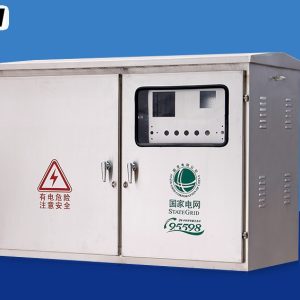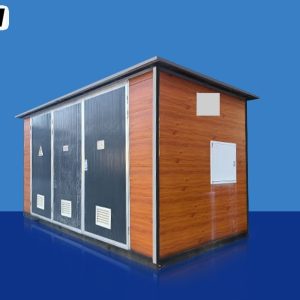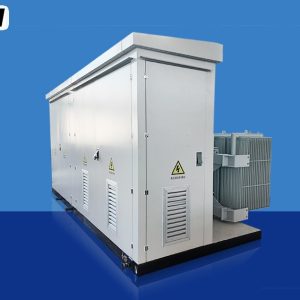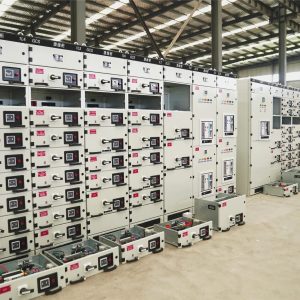
An outdoor compact substation is a switch room that has been turned inside out. Instead of a building holding a row of cabinets, a steel enclosure holds the medium-voltage board, the distribution transformer and the low-voltage panel, and it stands on a concrete pad in a yard. A person can walk in through a door, and everything inside is arranged for that person rather than for a crane. The design problem is not electrical, because the switchgear inside is ordinary. The problem is climate: sun on the roof, rain on the seams, humidity in the air and dust in the wind all act on a box that is only 30 mm of steel away from the live parts.
This family covers medium-voltage distribution in the 3.3 kV to 6.6 kV band, typically expressed as equipment classes Um 3.6 kV and 7.2 kV, and it is built to IEC 62271-200 for the medium-voltage part and to IEC 61439 for any low-voltage assembly inside the same enclosure. This page explains the ventilation arithmetic, why the roof is the hardest working surface on the unit, how condensation is controlled without letting dust in, and what separates a real outdoor enclosure from an indoor cabinet with a canopy bolted on top.
At a glance
| Voltage class, Um | 3.6 / 7.2 kV |
| Nominal systems | 3.3 / 4.16 / 6.3 / 6.6 kV |
| Construction | Walk-in, prefabricated, single enclosure |
| Degree of protection | IP54, dust protected and splash-proof |
| Enclosure finish | Galvanised frame, coated panels, or stainless |
| Ventilation | Louvred cross-flow with filters, fan optional |
| Anti-condensation | Thermostatic heaters plus breather |
| Roof | Sloped with drip edge and rain hood |
| Design standard | IEC 62271-200 and IEC 61439 |
The voltage labels in this band
Three nominal voltages circulate in this band and they come from two different traditions. The IEC metric series uses 3.3 kV and 6.6 kV, with equipment levels of Um 3.6 kV and Um 7.2 kV. North American practice uses 4.16 kV, which is the line-to-line voltage of a 2.4 kV system, and that value does not appear in the IEC series at all. A cabinet described as 4 kV is therefore either a 3.6 kV class unit serving a 3.3 kV network or a 4.16 kV unit built to a different standard, and the two are not the same hardware.
The pair that matters for a buyer is the equipment class. Um 7.2 kV carries a lightning impulse level of 60 kV and a power-frequency withstand of 20 kV, with a minimum air clearance around 90 mm and specific creepage of about 20 mm per kV in ordinary pollution. Those figures set the internal geometry of the medium-voltage compartment, and no amount of enclosure engineering changes them. The enclosure decides whether the insulation stays clean and dry enough to hold that geometry for twenty years.
A common listing error is to describe a 6.6 kV assembly as low voltage because the same enclosure also houses a 400 V distribution section. Both statements can be true of the same product and neither describes the whole product. The medium-voltage compartment is IEC 62271-200 equipment at Um 7.2 kV; the low-voltage compartment is an IEC 61439 assembly rated 690 V or below. Two standards, two nameplates, one enclosure.
Why a walk-in box, and what it changes
A walk-in enclosure exists because medium-voltage terminations are made by hand. A cable has to be stripped, a stress cone formed, a screen bonded and a connector torqued, and all of that happens at arm’s length with a tool in each hand. A pad-mounted cabinet with bolt-on elbows does the same job from outside, but only for a limited cable range and only with separable connectors. The walk-in box allows conventional termination, a proper cable support, a fault-rated barrier between compartments and a working aisle.
The aisle changes the thermal problem. A person generates about a hundred watts and needs air; a lamp adds more; and the door opens to the weather. The enclosure therefore has to breathe while keeping rain and dust out, which is done with louvres that turn the air path through at least two changes of direction. Water droplets and most wind-borne particles have enough inertia to hit the louvre blade and drain out, while air turns the corner. Insect mesh behind the louvre stops the next size of problem, and a removable filter stops the fine dust that would otherwise coat the insulators.
IP54 is the usual compromise for this construction. Under IEC 60529 the first digit of five means dust-protected rather than dust-tight: a limited quantity may enter, provided it does not interfere with operation. The second digit of four means protection against splashing water from any direction. That is enough for a unit standing outdoors with a roof over it, and it is deliberately not IP65, because a fully sealed box with a walk-in door and a transformer inside cannot reject its own heat.
Heat, sun and the ventilation budget
Inside an outdoor unit the heat comes from three places: the transformer losses, the switchgear losses, and the sun. The first two are electrical and calculable. The third is the one that surprises people. A dark painted steel roof in direct summer sun can reach 70 °C or more on its outer surface even when the air is at 35 °C, and that surface radiates and conducts into the space below it. A light-coloured roof, a ventilated double skin and a shaded air gap between the roof and the ceiling each cut that load, and each is cheaper than adding a fan.
The ventilation calculation is a mass-flow problem. Air entering at the bottom louvre and leaving at the top carries heat away in proportion to the mass flow and the temperature rise it is allowed to have. IEC 62271-1 fixes the reference ambient for the switchgear at 40 °C, with a 24-hour mean of 35 °C, so the internal air has to stay close to that while removing the losses. Silencer-free natural convection works up to a few kilowatts of loss; beyond that, thermostatically controlled fans are needed, and they become a maintenance item with a filter that must actually be changed.
| Item | Typical value | What it controls |
|---|---|---|
| Equipment class, Um | 3.6 / 7.2 kV | Air clearance, creepage and bushing length |
| Impulse withstand | 40 / 60 kV | Insulation coordination and arrester choice |
| Ambient used for rating | 40 °C, 35 °C daily mean | Derating above the reference |
| Internal rise above ambient | 5 – 15 K, ventilation dependent | Free louvre area and fan capacity |
| Roof surface in sun | Up to 70 °C or higher | Roof colour, insulation and air gap |
| Roof slope | 3 to 5 degrees minimum | Drainage and standing water |
| Heater duty | 100 – 300 W per compartment | Surface temperature above dew point |
| Louvre free area | Matched to loss, not to panel size | Air velocity and dust carry-over |
| Degree of protection | IP54 | Ingress versus heat rejection trade-off |
| Corrosion class | C3 to C5, site dependent | Coating system and fixing material |
The internal rise figure in that table is the one to interrogate in an offer. A manufacturer who states a five kelvin rise is claiming a very well ventilated enclosure; one who states fifteen is being honest about a compact box. Neither is wrong, but the difference decides whether a 6.6 kV board rated at 1 250 A can carry that current on a 38 °C afternoon in July.
Engineering note. Ventilation and condensation pull in opposite directions. Every louvre that lets heat out also lets humid air in, and every gasket that keeps water out also traps moisture. The resolution is not to pick one, but to heat and to ventilate at different times: heaters run when the enclosure is cold and closed, and ventilation runs when it is warm and the load is high. A thermostat on each function, with a dead band between their set points, prevents them fighting each other.
Roof, rain hood and the parts that fail first
Water does not enter through a wall. It enters at a horizontal seam, a fixing hole, a door gasket that has taken a set, or the top of a cable entry. A proper outdoor enclosure therefore has a roof that overhangs the walls by enough to throw a drip clear of the door, a drip edge folded into the roof panel so water cannot run back underneath, and a door opening that sits under that overhang rather than flush with the wall. A rain hood over a louvre does the same job for the air path: it turns the intake downward so wind-driven rain cannot follow the air in.
The base is the other weak point. Enclosures standing on a flat pad collect water at the bottom flange, and the first corrosion usually appears at the bottom 100 mm of the panel. A raised base frame, a continuous weld at the floor line and a plinth that sheds water away from the unit all extend life more than a heavier gauge of steel elsewhere. Cable entry from below through a sealed gland plate, rather than a simple hole, is the detail that decides whether the IP rating survives the first wet season.
Vermin deserve a mention because they are ignored in most specifications. Rodents enter through cable openings and nest in the warm space behind a heater; insects block louvre mesh and reduce the airflow the thermal design assumed. Mesh size, sealed entries and a removable screen that can be cleaned are cheap and decisive.
Outdoor enclosure against indoor switch room
| Criterion | Outdoor compact unit | Indoor switch room |
|---|---|---|
| Civil works | Pad and cable trench only | Building, fire separation, drainage |
| Climate control | Built in, and part of the rating | Handled by the building |
| Corrosion exposure | Direct, needs a coating class | Sheltered, ordinary paint is enough |
| Relocation | Possible with lifting points and a flatbed | Not practical |
| Footprint per MVA | Smallest total site area | Largest, includes access and clearance |
Where it fits
The unit serves loads that are remote from a main switch room: a pump station at the end of a pipeline, a quarry face, a construction site, a wind turbine base, a small industrial park where the developer does not want to build a brick substation, or a temporary supply that will move twice in five years. It usually contains a ring switch or an incoming breaker, a transformer of a few hundred to a couple of thousand kilovolt-amperes, and a low-voltage distribution section with a handful of outgoing ways.
Upstream is the medium-voltage cable from the network; downstream is the low-voltage feeder to the load. The transformer in the middle is what makes the thermal design difficult, because its losses are large, continuous and entirely inside the box, unlike switchgear losses which only matter when current is flowing.
Selection and commissioning checklist
- Start with the loss budget. Add transformer losses, switchgear losses and the solar load, then size the louvres and fans from that total rather than from the panel dimensions.
- Fix the ambient the unit will really see. A pad in full sun in a hot climate is not a 35 °C design case, and the derating that follows should appear on the nameplate.
- Specify the corrosion class from the site survey. Coastal, industrial and inland sites need different coating systems, and the fixings matter as much as the panels.
- Check the roof geometry. Slope, overhang, drip edge and a hood over every louvre are what keep water out of a door gasket.
- Separate the heater and fan set points. A thermostat each, with a dead band between, stops the two systems working against each other.
- Confirm lifting and earthing provisions. Four lifting points rated for the complete unit, and an earth bar that reaches every compartment, are needed before the pad is poured.
Frequently asked questions
Is IP54 enough for permanent outdoor use?
For a unit with a roof, a drip edge and a sealed cable entry, yes. IP54 protects against dust ingress in limited quantity and against splashing water. Driving rain at an angle onto a door gasket is the case that tests it, which is why the overhang matters more than the second digit.
Why not seal it completely and use air conditioning?
Because the losses inside are large and continuous, and a sealed box needs a cooling unit with its own power supply and maintenance. Ventilation with filters is simpler and cheaper wherever the outside air is not itself corrosive or heavily contaminated.
Can the transformer be outside the enclosure?
Yes, and that is common where the transformer is oil-filled and the enclosure holds only switchgear. It removes the largest heat source from the box, at the cost of a separate foundation, a firewall and a longer cable run.
Does a 4 kV label mean anything standard?
It usually refers to a 4.16 kV system, which is North American practice, or loosely to a 3.3 kV system served by Um 3.6 kV equipment. Ask for the equipment class and the impulse level rather than accepting the nominal figure.
Voltage class, transformer rating, ventilation arrangement, heater duty, coating system and door layout are all set per project, so the configuration follows from the load schedule, the site climate and the cable route.